The chain that toppled a national system
The misantropia attack, which fired fake alerts to millions of phones across Brazil in June 2026, did not start with a criminal mastermind. It started with cheap malware and a password nobody rotated. The sequence is the same in almost every 2026 incident:
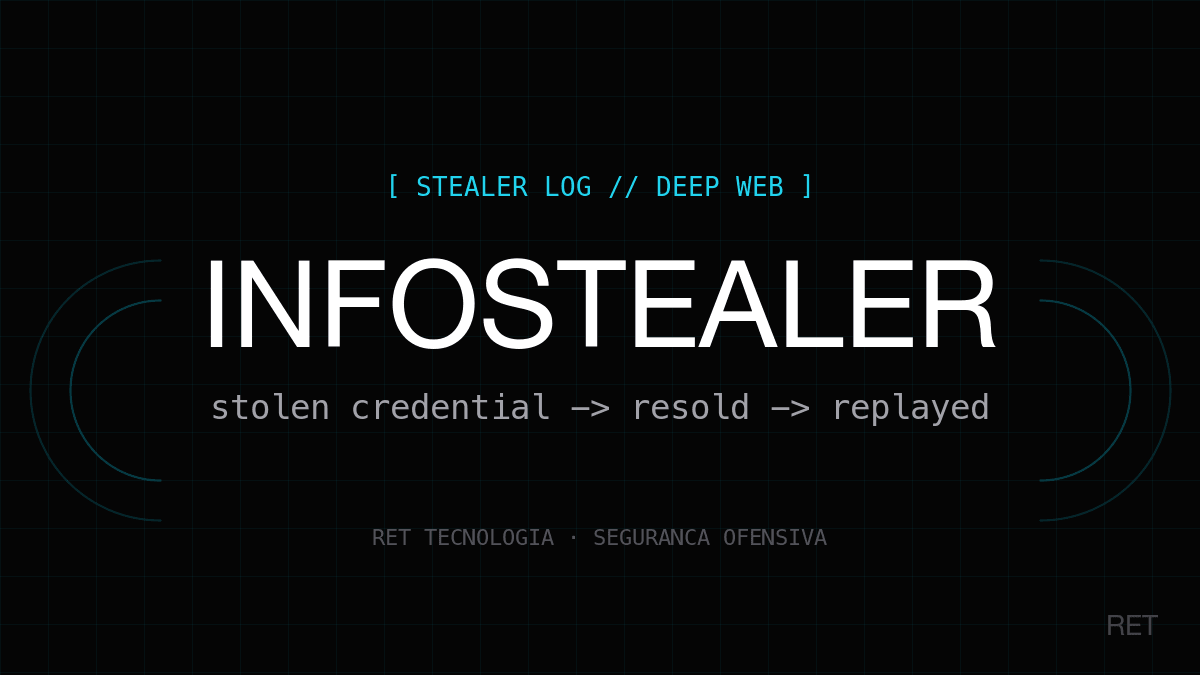
- An infostealer infects the machine of someone with access.
- Browser passwords are stolen in seconds.
- The data is resold on deep-web "stealer log" markets.
- An attacker replays those credentials (credential stuffing) on a panel or login.
- With no MFA, access works — and the damage begins.
Understanding each link is understanding how to close the door.
Link 1 — The infostealer
An infostealer is malware specialized in stealing saved data: browser passwords, session cookies, tokens, wallets. Families like RedLine, Lumma, Vidar and StealC are rented by subscription on Telegram channels — anyone with little technical skill can operate them. RedLine alone accounts for nearly half the cases in our region.
The infection vector is usually mundane: a pirated installer, an attachment, a fake extension, a "crack". The victim never notices — the malware collects and leaves.
Link 2 — The resale
Stolen credentials become a product. Stealer-log markets sell packs with login, password, cookies and the source site — organized and searchable. 1.8 billion credentials were stolen in the first half of 2025 alone, an 800% jump over the prior period, from 5.8 million infected devices.
That's why "my password is strong" isn't enough: password strength doesn't matter when the password is handed to the attacker whole.
Link 3 — Credential stuffing
Holding the credentials, the attacker automates: testing login/password pairs across services, betting on password reuse. That's how it worked on Civil Defense's IDAP — the leaked credential worked because the password was never rotated and there was no MFA. 54% of ransomware victims had their credentials for sale before the attack: the chain is the early warning almost nobody reads.
How to break each link
| Link | Defense |
|---|---|
| Infostealer | Updated EDR/antivirus, block pirated software, don't save sensitive passwords in the browser, password manager with a vault |
| Resale | Monitor corporate credentials on stealer logs and the dark web; rotate on detection |
| Credential stuffing | Phishing-resistant MFA, leaked-password blocking, rate-limiting, strong captcha, anomalous-login detection |
| Reuse | One unique password per service (manager), never reuse across personal and corporate |
The key point: the decisive defense is MFA. Even if links 1, 2 and 3 happen, a phishing-resistant second factor blocks access. That's what Civil Defense lacked.
What this means for your SaaS
If you run a product with login, an admin panel, payments or customer data, this chain is the most likely way you get breached in 2026 — not an exotic attack. The good news: every link has a known, cheap defense. RET reviews exactly this: where a leaked credential would enter your product, and what's missing to block it — in Risk Review and manual pentest.
Sources
Infostealer steals, the deep web resells, credential stuffing replays. The chain is cheap, automated and dominates 2026 — and it breaks at MFA. Without a second factor, your password is already the attacker's.